A prominent broiler breeder farm has relied on Pruex Products to enhance their production and address various challenges encountered on the farm. Notably, high mortality rates, unhealthy birds, damp bedding, and an excessive dependence on antibiotics.
This document aims to compare the performance of an average of 3 flocks on Pruex probiotics to 3 flocks not on Pruex probiotics.
It is important to note that no changes were made to:
- Their feed
- Vaccine program
- Environmental factors
PRUEX implemented a proactive biological performance programme on poultry farms to reduce bacterial disease challenges. By replacing harmful bacteria with beneficial ones, the solution improves animal welfare, performance, and reduces antibiotic dependency.
Swabs are taken on farm to determine the bacterial challenges that might be impacting negatively on poultry production.
The Pruex 3-pronged approach is then implemented:
- Burst open Biofilm with PIP Deep Clean – Probiotic cleaner.
- A void is created with the use of disinfectant. Fill this void with the use of PIP Air.
- Continuous dosing of PIP Water Plus to remove biofilm, improve water quality and to colonise the gut with bacillus.
Mortalities
Use of Antibiotics
The Pruex flock did not have any antibiotics during the 60 weeks of observation. The other flocks not on the probiotics had repeated doses of antibiotics. Some of these antibiotics include Colifox, Inteflox and Sulfacox to name a few.
Lower Mortality
The results below compare flocks without Pruex probiotics flocks on Pruex probiotics. Here are the key takeaways:
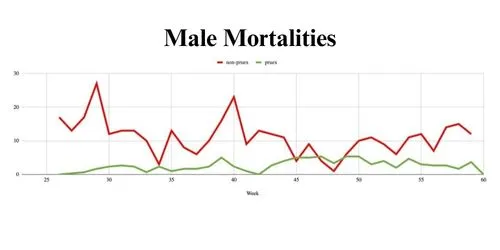
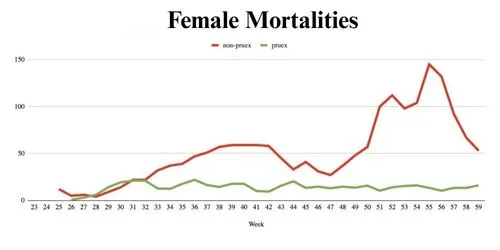
- For both male and females pruex flocks had a much lower mortality than non-pruex
- non-pruex had a cumulative mortality over 60 weeks of 21% compared to pruex of 6% in females.
- In males non-pruex had a cumulative mortality of 48% compared to pruex of 25%
- At week 25 the female flock size is 14 000. The non-pruex flocks lost 2940 females whereas the pruex flock only lost 840 females.
Increase in Egg Production Percentage
The results below compare non-pruex flock to pruex flockHere are the key takeaways:
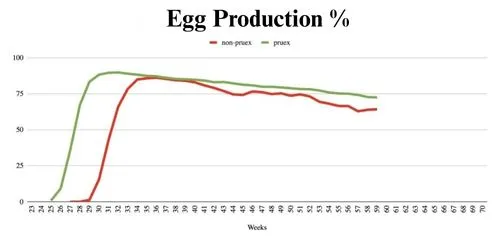
- Pruex had a high overall egg production percentage compared to non-Pruex.
- Pruex’s average egg production percentage was 8% higher than non-Pruex over a 59 week period.
- At the end of the 59 week period, pruex’s egg production percentage was 72.8% compared to non-pruex of 64.2%
- Pruex egg production percentage peaked at 90% compared to non-Pruex of 86%
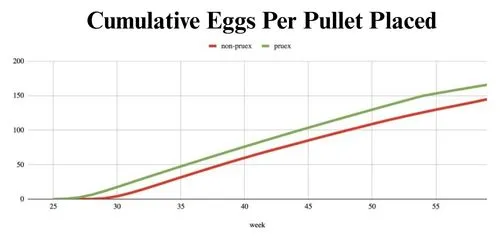
Increase in CUMM Eggs per Pullet per House
The results below compare non-pruex flock to pruex flock. Here are the key takeaways:
- Over the 60 week period the pruex flock came into lay earlier than non-pruex flock,
- The pruex flock had an overall higher cumulative eggs per hen per house than non-pruex flock.
- Pruex flock on average produced 12% more eggs per Pullet per week than non-Pruex.
Hatchability Results
The results below compare non-pruex flock to pruex flock. Here are the key takeaways:
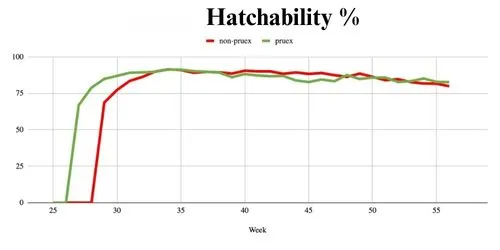
- Over the 55 week period the pruex flock came started off with a higher hatchability than the non-pruex flock.
- The pruex flock had a higher average hatchability of 86% compared to the non-pruex flock of 80%.(See graph below)
OTHER COMMENTS
- Reduction in egg peritonitis
- Reduction in antibiotic usage
- No ammonia smell on bedding
- Fewer flies